Made to Stick
SUCCESs framework for memorable messaging
Make your ideas unforgettable using the SUCCESs framework from Chip and Dan Heath. This skill helps your AI agent craft messages that are Simple, Unexpected, Concrete, Credible, Emotional, and told as Stories.
npx skills add wondelai/skills/made-to-stick --global 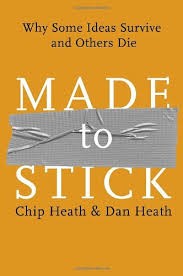
Made to Stick Chip & Dan Heath View on Amazon
02 What it is
What is the Made to Stick skill?
Made to Stick gives your AI agent the SUCCESs checklist from Chip and Dan Heath’s book: Simple, Unexpected, Concrete, Credible, Emotional, Stories. Point it at a tagline, a pitch deck or a launch email and it scores all six traits, names the two dragging the message down, and rewrites them — usually by curing the curse of knowledge.
03 Key concepts
Five principles your agent applies.
Drawn from Made to Stick — not advice it repeats back to you, but decisions it makes while it works.
04 Fit
When to use it, and
when not to.
four symptoms it fixes, and four it doesn't.
Reach for it when
Your team can recite the value proposition; customers who heard it last week cannot repeat a word of it.
The product page is accurate, complete, and made entirely of abstractions like seamless, platform and end-to-end.
You have explained the product so often you can no longer hear which parts only make sense to insiders.
A strategy or launch deck has to survive being retold third-hand by people who were not in the room.
Reach for something else when
The message is memorable but nobody passes it on. Contagious handles transmission, not recall.
You have not decided what you are or who you are for yet. settle that with Obviously Awesome.
You want a full narrative arc across a homepage and nurture sequence. StoryBrand Messaging supplies it.
You need to know whether customers care at all, not whether the phrasing lands. The Mom Test asks better.
05 Prompts
Say it like this.
Name the skill at the end of a prompt and the agent applies the framework rather than a vibe. Or say nothing — it loads on its own when a task matches.
Make this product announcement stickier using the SUCCESs checklist using made-to-stick skill
Rewrite this feature description to be more concrete and unexpected using made-to-stick skill
Create a sticky tagline for our new product launch using made-to-stick skill
Turn this case study into a story that sells using made-to-stick skill
06 About the author
07 Same stack
The stack it sits in.
Six Marketing & Messaging skills. Most people run two: this one, and whichever fits the next problem.
All Marketing & Messaging skills08 Questions
Before you install.
How do I install the Made to Stick skill?
Run npx skills add wondelai/skills/made-to-stick --global. It takes about 30 seconds and needs no account. The Made to Stick skill then works in Claude, Claude Code, Claude Cowork, Codex, Cursor, OpenClaw and Hermes Agent — anything that reads the open agentskills.io format — and your agent loads it on its own when a task calls for it. It is free and MIT-licensed, and the source is at https://github.com/wondelai/skills.
Which book is the Made to Stick skill based on?
It packages Made to Stick by Chip & Dan Heath — stanford & Duke professors, four-time NYT bestselling authors. The skill distils the book's method into instructions your agent follows while it works, covering simple, unexpected and concrete. It sits in the Marketing & Messaging part of the library.
StoryBrand, Made to Stick, Contagious — which one do I actually need?
They answer different questions. StoryBrand asks whether your copy is structured as a story with the customer at the centre. Made to Stick asks whether one idea survives a single hearing and gets repeated accurately. Contagious asks whether anyone has a reason to pass it on at all. A message people remember perfectly and never mention is a Made to Stick success and a Contagious failure. Reach for this one when the pitch is forgettable rather than unstructured.
What does SUCCESs stand for, and do I need all six?
Simple, Unexpected, Concrete, Credible, Emotional, Stories. The Heaths are explicit that it is a toolkit rather than a checklist — the stickiest ideas use several, rarely all six, and forcing every trait onto a short message makes it worse. The skill rates each trait, maps the total to a score out of ten, then fixes the two lowest instead of padding your copy until the acronym is satisfied.
What is the curse of knowledge, and why does the skill keep raising it?
Once you know something you cannot imagine not knowing it, so experts explain in abstractions that felt concrete to them years ago. It is the single biggest reason internal messaging dies outside the building. The skill treats it as the default diagnosis: when copy scores badly on Concrete, the cause is usually not lazy writing but a writer who has forgotten what the reader does not already have in their head.
Can it make a genuinely boring product memorable?
Up to a point, and the ceiling is worth naming. Unexpected only works when there is something truly counterintuitive to say, so the skill will dig through your data, your process and what customers get wrong about the category looking for it. What it will not do is invent one — a surprise that is not true fails the Credible trait in the same pass. Sometimes the honest output is a plain message rather than a clever false one.
09 Guides that use it
Put it to work.
Long-form playbooks where this skill does part of the job.
One skill, one command.
Install Made to Stick, or the whole stack.
npx skills add wondelai/skills/made-to-stick --global MIT licensed · Claude, Claude Code, Codex, Cursor, OpenClaw, Hermes · No account