Good Strategy Bad Strategy
Strategy kernel: diagnosis, guiding policy, coherent action
Replace goal lists and vision decks with real strategy using Richard Rumelt's Good Strategy Bad Strategy. This skill equips your AI agent with the strategy kernel — honest diagnosis, guiding policy, coherent action — plus detection of the four hallmarks of bad strategy and the sources of power that make strategy work.
npx skills add wondelai/skills/good-strategy-bad-strategy --global 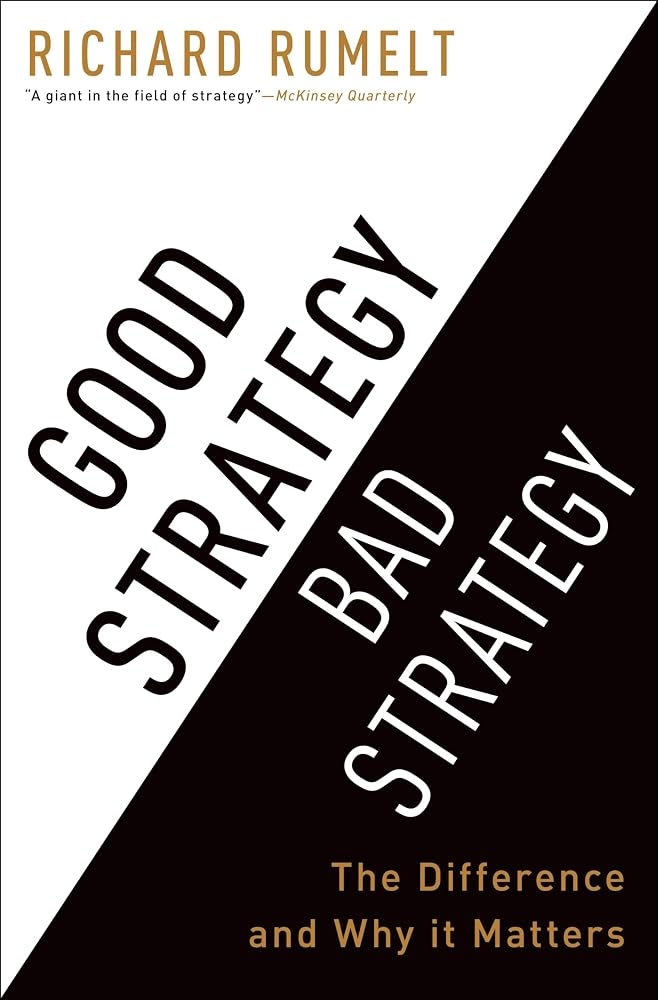
Good Strategy Bad Strategy Richard Rumelt View on Amazon
02 What it is
What is the Good Strategy Bad Strategy skill?
Good Strategy Bad Strategy is the free skill that hands your AI agent Richard Rumelt’s test for whether a plan is a strategy. It scores yours against the kernel — an honest diagnosis of the critical challenge, a guiding policy, coherent actions — names the four hallmarks of bad strategy it finds, and rewrites the plan as a real one.
03 Key concepts
Five principles your agent applies.
Drawn from Good Strategy Bad Strategy — not advice it repeats back to you, but decisions it makes while it works.
04 Fit
When to use it, and
when not to.
four symptoms it fixes, and four it doesn't.
Reach for it when
The annual plan names forty priorities, which is another way of saying the company has concentrated nothing.
Every sentence in the deck would survive unchanged if a competitor pasted it into theirs.
Leadership keeps arguing about tactics because nobody has agreed what the central obstacle actually is.
You need a list of what the company will stop doing, and no such list exists.
Reach for something else when
The diagnosis is settled and you need weekly machinery. Traction EOS turns direction into Rocks and meetings.
You want a concrete competitive move generated for you. Blue Ocean Strategy produces candidates to test.
The constraint is your own week and management habits. High Output Management works at that scale.
You are pre-product and the real question is whether anyone wants this. The Mom Test answers it cheaper.
05 Prompts
Say it like this.
Name the skill at the end of a prompt and the agent applies the framework rather than a vibe. Or say nothing — it loads on its own when a task matches.
Audit our strategy doc for the four hallmarks of bad strategy using good-strategy-bad-strategy skill
Turn this list of goals into a real strategy kernel using good-strategy-bad-strategy skill
Write a one-page kernel for our product: diagnosis, policy, actions using good-strategy-bad-strategy skill
Find the leverage point and proximate objective for next quarter using good-strategy-bad-strategy skill
06 About the author
07 Same stack
The stack it sits in.
Four Strategy & Growth skills. Most people run two: this one, and whichever fits the next problem.
All Strategy & Growth skills08 Questions
Before you install.
How do I install the Good Strategy Bad Strategy skill?
Run npx skills add wondelai/skills/good-strategy-bad-strategy --global. It takes about 30 seconds and needs no account. The Good Strategy Bad Strategy skill then works in Claude, Claude Code, Claude Cowork, Codex, Cursor, OpenClaw and Hermes Agent — anything that reads the open agentskills.io format — and your agent loads it on its own when a task calls for it. It is free and MIT-licensed, and the source is at https://github.com/wondelai/skills.
Which book is the Good Strategy Bad Strategy skill based on?
It packages Good Strategy Bad Strategy by Richard Rumelt — UCLA professor emeritus, "the strategist's strategist". The skill distils the book's method into instructions your agent follows while it works, covering the kernel, bad strategy detection and sources of power. It sits in the Strategy & Growth part of the library.
What does Rumelt mean by the kernel?
Three parts, and each has a job. The diagnosis simplifies a messy situation by naming the one obstacle that matters, usually through an analogy that reframes what you are dealing with. The guiding policy is the overall approach for getting past it, and it must rule things out to count. Coherent actions are the coordinated moves that carry the policy — coordinated meaning they reinforce each other rather than sitting on a list.
How is this different from the Traction EOS skill?
This one decides what to do; Traction EOS makes the company do it every week. Rumelt is silent on meeting cadence, scorecards, and who owns which seat — his subject is whether your direction survives contact with a hard question. EOS is silent on whether your direction is any good; it will cascade a weak strategy into quarterly Rocks with perfect discipline. Diagnose here, then install the rhythm there.
Should I read the book as well?
The skill carries the audit and the rebuild — the hallmarks, the kernel, the sources of power like leverage, focus, proximate objectives, and chain-link systems. What it cannot compress is the reasoning inside the cases, such as Lou Gerstner reframing IBM’s 1993 crisis from “mainframes are dying” to “our advantage is integration and the obstacle is internal coordination.” That is what teaches you what a diagnosis feels like when it lands.
Will it produce a strategy for me?
It will produce a well-formed kernel from what you give it, and it will be blunt about goals wearing a strategy costume. It cannot supply the facts — the real diagnosis comes from your market, your numbers, and things only your team knows. Expect a low score on the first pass; most working plans land around three or four. Expect too that a genuine guiding policy will make somebody unhappy, because it says no.
09 Guides that use it
Put it to work.
Long-form playbooks where this skill does part of the job.
One skill, one command.
Install Good Strategy Bad Strategy, or the whole stack.
npx skills add wondelai/skills/good-strategy-bad-strategy --global MIT licensed · Claude, Claude Code, Codex, Cursor, OpenClaw, Hermes · No account