Cold Start Problem
Network effects: launch and scale networked products
Launch and scale products that live or die by network effects — marketplaces, social apps, and collaboration tools — using Andrew Chen's framework from The Cold Start Problem. This skill equips your AI agent with the five stages of network growth, from building one atomic network to defending the moat at scale.
npx skills add wondelai/skills/cold-start-problem --global 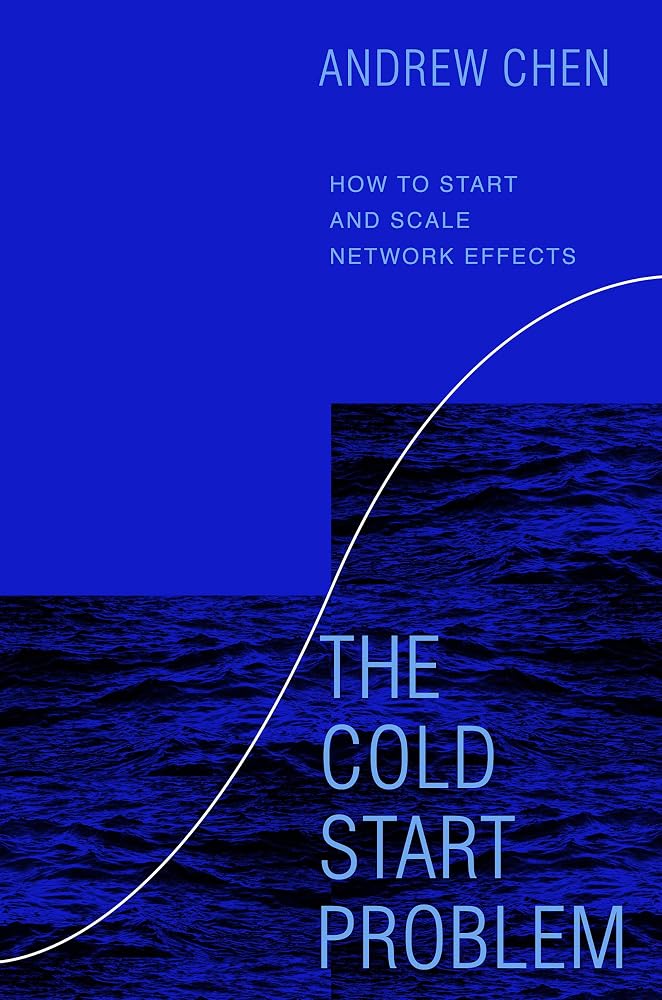
The Cold Start Problem Andrew Chen View on Amazon
02 What it is
What is the Cold Start Problem skill?
The Cold Start Problem skill turns Andrew Chen’s book into instructions your AI agent can run on a product that is worthless until other people show up. It works the five stages of network growth: assemble one atomic network dense enough to stand alone, win the hard side, tip network after network, then hold the ceiling.
03 Key concepts
Five principles your agent applies.
Drawn from The Cold Start Problem — not advice it repeats back to you, but decisions it makes while it works.
04 Fit
When to use it, and
when not to.
four symptoms it fixes, and four it doesn't.
Reach for it when
Your marketplace has listings and visitors, but neither side finds enough of the other to return.
You launched across a whole city or company at once and the network never reached density anywhere.
Signups keep climbing while engagement per user falls — the network is spreading thinner, not deeper.
The supply side — sellers, creators, drivers, moderators — churns out faster than you can recruit replacements.
Reach for something else when
Your product is useful to a single user on day one. Crossing the Chasm fits that growth path better.
You need habit loops inside the product rather than density around it. Hooked UX covers that.
Nobody can tell whether the numbers are improving. Lean Analytics picks the metric for your stage.
The idea is unvalidated and you are guessing at demand. The Mom Test costs less than any launch.
05 Prompts
Say it like this.
Name the skill at the end of a prompt and the agent applies the framework rather than a vibe. Or say nothing — it loads on its own when a task matches.
Design an atomic network launch plan for our two-sided marketplace using cold-start-problem skill
Identify the hard side of our network and how to win them first using cold-start-problem skill
Audit our growth plan for big-bang launch and vanity metric traps using cold-start-problem skill
Diagnose why our marketplace growth stalled and which ceiling we hit using cold-start-problem skill
06 About the author
07 Same stack
The stack it sits in.
Four Strategy & Growth skills. Most people run two: this one, and whichever fits the next problem.
All Strategy & Growth skills08 Questions
Before you install.
How do I install the Cold Start Problem skill?
Run npx skills add wondelai/skills/cold-start-problem --global. It takes about 30 seconds and needs no account. The Cold Start Problem skill then works in Claude, Claude Code, Claude Cowork, Codex, Cursor, OpenClaw and Hermes Agent — anything that reads the open agentskills.io format — and your agent loads it on its own when a task calls for it. It is free and MIT-licensed, and the source is at https://github.com/wondelai/skills.
Which book is the Cold Start Problem skill based on?
It packages The Cold Start Problem by Andrew Chen — general Partner at Andreessen Horowitz, former Uber growth lead. The skill distils the book's method into instructions your agent follows while it works, covering atomic networks, the hard side and the tipping point. It sits in the Strategy & Growth part of the library.
What is an atomic network?
The smallest group for which the product already works without life support — one dorm, one office, one commuter route, one hobby community. Below that size people show up, find nothing, and leave. The counterintuitive instruction is to shrink until you can over-serve a tiny group completely, rather than spread a thin layer of users across a whole city. Everything in the framework downstream assumes you built one first.
How is this different from the Crossing the Chasm skill?
Moore’s problem is credibility: your product works, and the next group of buyers doesn’t trust it yet. Chen’s problem is density: your product does not work yet, because the value is other users and there aren’t enough of them. That changes the fix. Crossing the Chasm sends you after references and a whole product; Cold Start Problem sends you after the hard side, seeding mechanics, and the one network small enough to saturate.
Do I need to read The Cold Start Problem to get value from this?
No — the stages, the hard-side diagnosis, and the ceiling patterns are all in the skill, and it will apply them to your own funnel and cohort numbers. The book is largely a collection of company stories, from Uber to Tinder, and those are what make the abstract stages legible. Read it when you want the texture; use the skill when you need next week’s launch plan.
What are the limits of this skill?
It only helps products whose value comes from other users — a single-player tool gets nothing from it. And plenty of the seeding tactics in the book were run with venture money behind them, so treat subsidies and giveaways as the expensive option rather than the default. The framework gives you a vocabulary for diagnosing where a network is stuck; it does not promise the network was ever going to work.
09 Guides that use it
Put it to work.
Long-form playbooks where this skill does part of the job.
One skill, one command.
Install Cold Start Problem, or the whole stack.
npx skills add wondelai/skills/cold-start-problem --global MIT licensed · Claude, Claude Code, Codex, Cursor, OpenClaw, Hermes · No account